Introduction - “So, what does a product manager do?”
“Hello, so what do you do?”
“I’m a product manager!”
“Great so… what do you actually do?”
So many conversations about my job start like this. Even though “product manager” has become a common term in tech company speak (and beyond), it still doesn’t have a single definition. Nor is there a “main thing” that a product manager is supposed to do.
A software engineer writes code, a designer produces digital or physical product designs and a product manager… writes doc? Isn’t that a copywriter? For a while the easiest way that I was describing a product manager as is everything that all the other jobs are not. A PM (short for product manager, though as we’ll see also many other roles) isn’t a software engineer, isn’t a designer, isn’t a marketer etc… All the things that are necessary to run a company but that don’t fall into any of the “known” roles then, that’s what a product manager is.
By this point any dinner or networking conversation has moved on, though I often get asked by people interested in product management what the role entails. The answer ends up being a subset of what is in this article, so I decided to write it down based on my experience working in, looking for, interviewing for (on both sides) product management roles.
Why should you care about the definitions of product managers
If your world is going to even tangentially intersect product management, whether you want to become one, hire one, manage one or even work with one, you will be immensely more successful in what you do if you understand that “product management / PM” isn’t a single role and that, without further details, it means so many things that, effectively, it means nothing.
If you’re interviewing for a PM position, you should really strive to understand which one, of the different types of PMs listed below, the role really is about and only accept the role if it aligns with your expectations. If, during an interview process, you can’t tell what type of role you’re interviewing for, that’s a red flag. The simpler way to operate with regards to said job would be to just stay away. If instead you really like the company, then you can counter the hiring manager by clearly stating the type of PM that you want to be and seeing if that aligns with their expectation. There are a lot of companies out there (especially start ups) that are hiring PMs though they don’t really know what they’re hiring for. In that case, it is your responsibility as a candidate to coach them on what the most impactful type of PM they should be hiring for given their company stage and needs. This article should help you with some frameworks you can walk your hiring manager through to help them understand what they need.
Likewise, if you’re hiring a PM, then you want to be as specific as possible in the job description as to what kind of tasks the role is supposed to cover and what kind of skills the candidate should have. This will ensure that the person being hired ends up being successful in the role and not end up doing things that they’re both not skilled at and not interested in learning. You’ll be surprised to find that often people interviewing for a PM role don’t actually know what the role entails and apply to the PM role because it is the most generic of roles offered by a company they want to apply to. It is your responsibility to find out what the person really wants to do and whether the role is an actual match.
What are we going to cover
- All the abbreviations of PM: differences and similarities between program, project and product managers
- A one dimensional framework to classify product management jobs
- The most common product manager types
The “PM”: program, project and product managers
PM is a common abbreviation of the product management title, though it actually stands for any one of product, project or program.
From a reputation perspective a “product management” title is usually perceived as more prestigious compared to a project or program management title. For that reason, non-product managers use the “PM” abbreviation to blur the lines and pretend to have the title of product manager.
When you ask a product manager whether their job is project management you often get answered with scorn. “Definitely not” they will say.
When you ask a project manager whether their job is product management, they will make you intend that it is the same without specifically saying that it isn’t, purely due to the title difference.
In a moment we’ll dive into the specific differences between these titles and how they’re used in industry, however, let’s make one thing clear before we start.
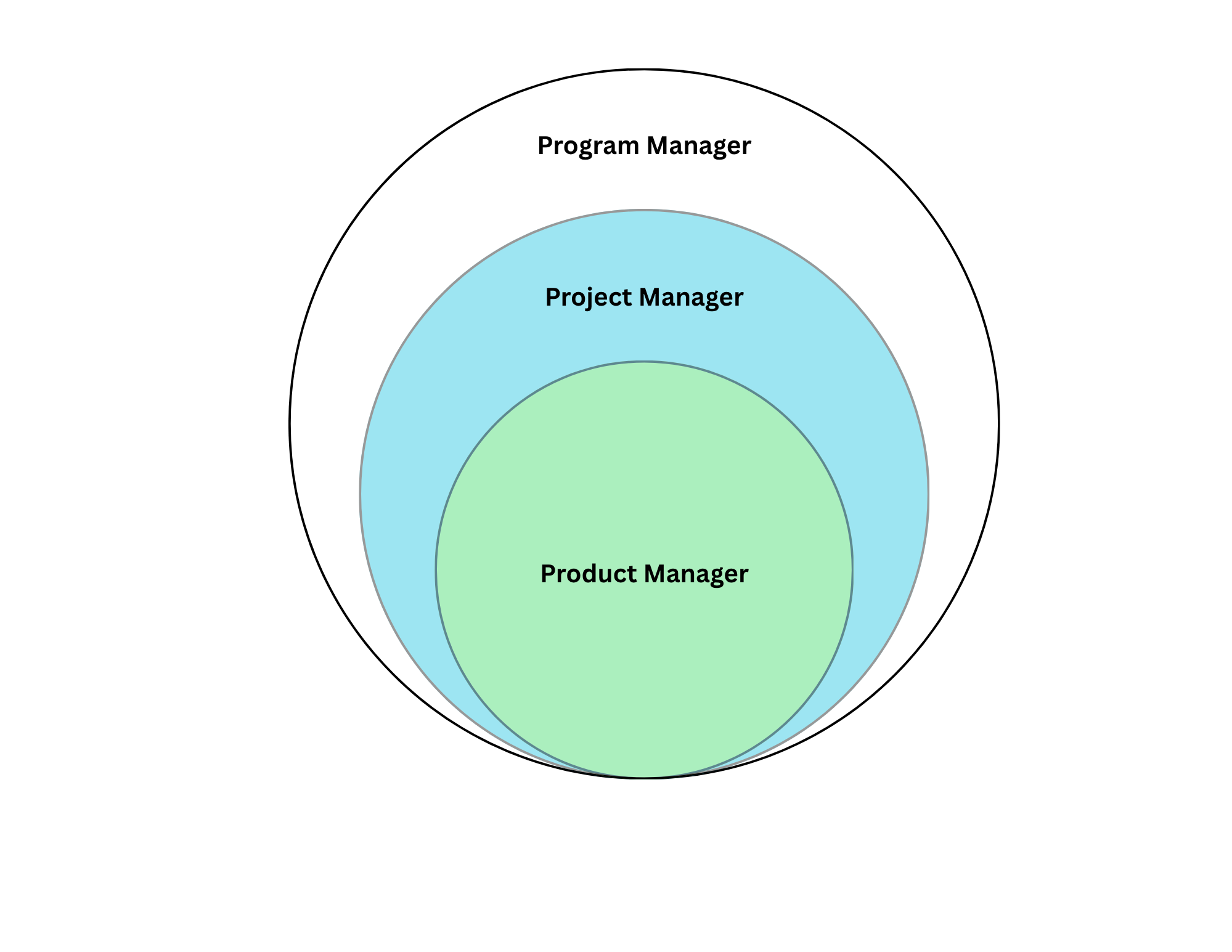
Even though product managers will distance themselves from project management roles, I HAVE NEVER SEEN A SUCCESSFUL PRODUCT MANAGER THAT ALSO ISN'T A SUCCESSFUL PROJECT MANAGER. In fact, instead of different roles, I see program, project and product management jobs to be subsets of each other when it comes to skills. Just like we’ll see for specific product management roles, some companies use those roles interchangeably, whereas others may adopt different naming conventions compared to the one that I am going to define below. According to the framework below, the three roles have distinct scopes, though as we progress from program -> project -> product the skills needed to succeed in the role increase in number.
Let’s dig into a framework to differentiate the roles.
Program Manager
In tech companies, the role of a “program manager” is usually associated with non technical teams such as creative, design, marketing, finance etc.
A program manager’s major focus is usually to oversee and manage a process that dictates the work of a team, ensuring and standardizing inputs and outputs.
The setting is usually a support or shared service team that acts upon requests from other teams and provides an output, either for the specific requester or for both the requester and the rest of the company. The program manager is usually the person responsible for:
- Creating any forms or inbound process to collect information about the request
- Review the requests for completeness
- Queue up and schedule the work to the team (given usually there are multiple competing requests)
- Keep communication with the requester to ensure they are updated
- Update documentation for the team, such that requesters can usually self serve on getting information on the status of the request
- Deliver the completed work to the requester
- Organize, lead and take notes (this part hopefully AI will take care of soon) in meetings
Some example of these processes that I have encountered or heard about:
- Creative teams
- Request for the creation of designs (digital or physical)
- Request for the creation of components for a shared design system
- Marketing
- Request for the creation of videos for marketing or PR campaigns
- Request for the creation of email campaigns
- Finance
- Request for creation of specific expense codes or accounting line items
- Purchasing
- Request for purchase orders
For example, at NVIDIA I worked with a packaging team. The packaging team had an excellent program manager. Every time I needed a packaging designed (and executed) I would place a request with them. They would let me know all the details that I needed to provide (since they also handled the interface with marketing to come up with the wording - “copy” in marketing jargon - for that particular product), and at standing weekly check in meetings they would brief me (among many other things) on the progress of the work, expected milestone dates, show me blueprints to check in on progress and, when undoubtedly we had to change something, let me know the consequences on timeline which was also driven by other packaging projects that were ongoing for other teams.
Roles and responsibilities sound familiar? As a project or product manager you will probably also do all of these and some more. So let’s move on to the project manager to see what else that role entails
Project Manager
“Project management” spans a variety of roles that I feel are fairly similar and can be grouped together. The main groupings of these roles are:
- Initiative specific project manager = this is a project manager assigned to a specific, cross functional (either purely internal or internal + external to the company) initiative that has a clear start and end date
- Tech team project manager = this is a more technical version of the program manager that handles a team’s commitments and that focuses A LOT on when specific milestones or projects of the team will get done
- All the agile scrum roles (product owner, scrum master etc) = these are covered extensively in many articles so I won’t cover them here
Even though I use different names here to differentiate the first two, the official title across the two is usually just “project manager” or “technical project manager”. So don’t go looking for “initiative project manager” job titles since you’ll most probably not find any.
Special note
The main reason I won’t cover agile / scrum roles is that, in “contemporary” and “cool” Silicon Valley tech companies that I’ve worked or interfaced with, these scrum roles essentially don’t exist anymore. I’ll write another article about the state of agile and scrum, though from my point of view, strict definitions of it are dead and everyone does their own interpretations. Product owner & scrum master responsibilities usually fall on project or product managers or engineering managers.
Initiative specific project managers
It is fairly common for companies to undergo big initiatives that touch many teams and, sometimes, also third parties outside the company. Especially as these initiatives start involving a lot of people, it is essential to ensure that all interdependencies are accounted for and that all teams know (and are hitting) their milestones and deliverables.
The main responsibility for this role are:
- Help define and own the roadmap for the specific initiative from start to end
- Identify all teams that the initiative touches (there’s always some teams that are let out at first, so this isn’t always as straightforward as it seems)
- Clarify to each team what their deliverables are
- Understand dependencies between each teams (since when milestones delay the project manager has to identify who is impacted by that)
- Communicate status and progress of the initiative to all stakeholders
In order to do this effectively, the project manager usually has to:
- Understand what all involved teams and stakeholders actually do as their day to day job
- Understand (and document) what has to be done for each team to satisfy the requirements of the initiative
- Negotiate on delivery dates (trying to get teams to be efficient)
Conversely, these are the behaviors of bad initiative project managers:
- They blindly collect and sequence dates without actually understanding what each date is for
- They buffer dates and inflate durations to protect themselves from milestones that slip (resulting in never ending initiatives)
I have seen one or both of these bad behaviors often. If you see them, they are key signals that the initiative is not going well. See the article on urgency.
Examples of projects that might require a project manager:
- A specific important product launch that touches many teams (usually the case in scale ups)
- Internal migrations from one software to another (common for finance, HR, procurement or program management software)
- Transition to adherence to specific compliance norms (ISO etc)
- Mergers
Given the non permanent nature of these positions (though some initiatives can go on for years, especially software migrations in multinational companies with offices all around the world), sometimes a person who is not a PM can be selected as the de facto project manager for the initiative, returning to their previous duties once the initiative is finished.
Team (tech) project manager
You can consider this role as a more “tech heavy” version of the program manager. They are usually assigned to a single team that contributes to the work of other teams (service team) and whose work is mainly driven by external dependencies. Most of the job responsibilities are similar to the program manager’s above, with the difference that the project manager handles a lot more of the day to day organization of the work of the team and leverages many more tools and automation to track and optimize the performance of the team. Program managers tend to do more of the same with more manual processes.
The main responsibility for this role are:
- Handle and automate the intake of requests for a team
- Communicate to stakeholders the delivery dates of the projects
- Prioritize the list of requests / backlog of the team
- Establishes automatic processes, for the team to work in a more efficient manner
- Report on performance, resourcing levels and metrics such as development speed of the team
- Keep track (ideally in a centralized tool) of work assignments of each team member
- Break down requests into milestones to accelerate delivery
Good project managers:
- Leverage work / project management tools (like Jira, Linear, Asana etc) effectively and not excessively
- Automate reporting
- Understand which dates can slip and which don’t, setting targets and sequencing projects appropriately
Bad project managers:
- (externally to the team) Don’t question delivery dates provided by stakeholders and fail to deprioritize other projects when new projects have to be prioritized higher
- (internally) Always set lax dates and easily push them out without questioning delays from the team
- Don’t understand what their team actually does and how to measure their performance
- Fail to recognize dependencies for work completion
If you currently are a PM, you’re probably noticing that all of the above are also true for Product Managers. Let’s now dive more in all the product manager roles, since those also span a wide spectrum.
The Product Management Spectrum
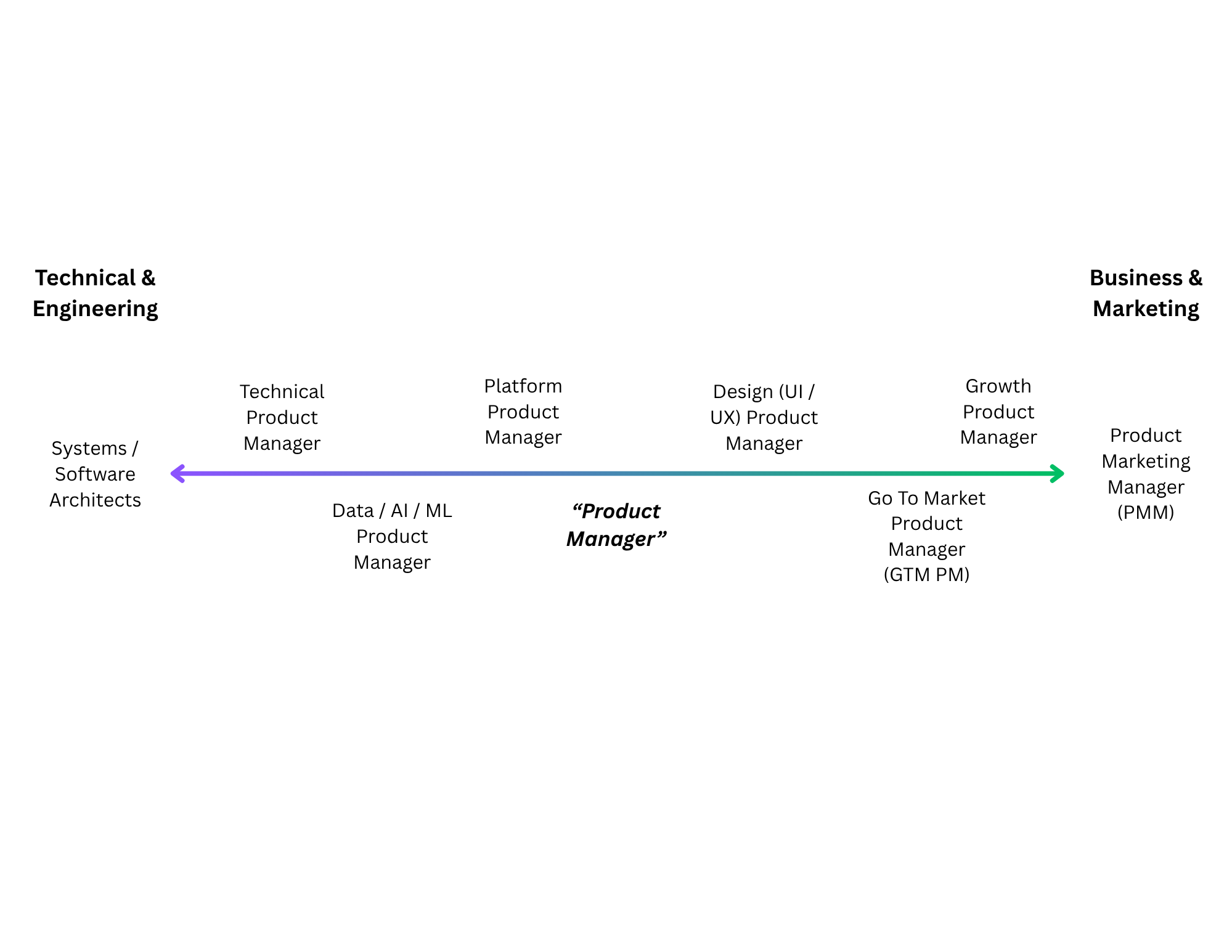
There are many ways that different product management roles can be classified and divided. I’ve seen all kinds starting from plots all the way to complex tables with many attributes. I’m going to present here a one dimensional spectrum that goes from very technical roles that borderline that of a software architect to more business focused roles that span into marketing. This is just a framework, it is not the only way to depict the product management landscape (I will write another article that covers what frameworks actually are) and there are other valid ways to label and identify different types of product roles. So keep an open mind and let’s identify product management roles!
Understanding the extremes
On one extreme (the left) of the spectrum is the technical ability of the role. “Technical” in technology related companies, when related to job positions, refers to the understanding and expertise that the person needs to have in the specific technology that they will be interfacing with (usually the main focus of the company).
For software and data, this usually means knowing how to code, understanding about software architecture (microservices, monoliths…), understanding about software interfaces (APIs, protobufs…), knowledge of databases (structured, unstructured), understanding of how machine learning and AI work, knowledge of some machine learning packages and algorithms (scikit learn, tree models, linear regression, pytorch, keras…) etc.
For hardware and systems, this usually means understanding the components types that go on chips and boards (resistors, capacitors, modems, SoCs, radios, ports, mux, memory…), mechanical engineering processes (molding, stamping, extruding, polishing…), materials (steel types, aluminum properties, plastic types, conductive materials…), assembly processes (DFM - design for manufacturing, fabs, OS - operating system flashing, QA - quality assurance / QC - quality control), some knowledge of physics (thermal dissipation, electromagnetic noise…) etc.
On the right is the business and marketing side of the role. These are skills that you would identify with an MBA degree such as business plans, launch plans, end customer understanding and segmentation, communication plans, PR, conversion funnels, etc. Lately on this side of the spectrum it’s also important to know about how growth marketing and digital ads work, design thinking and user interviewing, influencer marketing, community building and management (both developer and end user) etc.
Based on the definitions above the logical conclusion is that the “product spectrum” does not exist in its own world, but is continuous leading to engineering on the left side and business development & marketing on the right side. Two other important business areas that a product manager is usually associated with are design and operations. If we wanted to make the framework more complicated, we could transform the spectrum line into a diamond, with design at the top and operations at the bottom. However, for the sake of simplicity, we’re going to keep it linear and you can imagine there being a “softer” line that has operations on the left and design on the right. They don’t go quite all the way, we can say that they start from 25% and go to 75%.
In order to understand the extremes, it is helpful to think about the role that lies just outside of product in this spectrum. On the engineering side, we would encounter a (software or systems) architect (not to be confused with a solutions architect, which is at the intersection of engineering and sales). On the marketing side we would get into a product marketing manager and right after that a growth marketing manager.
I will include architect and product marketing manager in the product role description, given in some companies it is very likely that those roles would end up doing a big chunk of product work and, as a product manager, you will find yourself interfacing with them more like product peers rather than as representative of other functions.
Types of product managers
It took a while to get here… if you’re still reading, here’s my opinionated list of the product manager types, going from the most technical / engineering oriented to the most business / marketing one (from left to right on diagram above).
Systems or Software Architect
As mentioned earlier, even though hardware and software architects are not really product managers, it is helpful for product people to know what they usually do. The main outputs of architects usually are… diagrams! These diagrams are supposed to show how different components of the system (either hardware of software) relate to each other
Main responsibilities:
- Explore and understand all the components needed in a system to achieve specific goals
- Define how the different components could interface with each other in order to achieve the goal (and put it in a diagram!). Spoiler: there’s usually multiple ways to achieve the goal
- Tradeoff different components and solutions to identify the best option (best is relative to the company though it is usually a tradeoff of cost, quality and features)
- Provide detailed directions to the engineering teams around how to connect the different components (after the solution has been chosen)
- Be the expert at the company of how all the different systems that make up the company’s products work together
- Document (directly or through delegation) the system before, during and after it is built to ensure knowledge is written down!
Metrics they optimize for:
- Fulfilling the product goals set forth for the project
- Engineering performance metrics such as latency, error rate, cost, FLOPS (for compute platforms), power usage, bandwidth, accuracy / AUC (for machine learning systems) etc
Good architects:
- Can provide different level of abstractions of the diagrams depending on the audience; they understand what execs and non technical people care about understanding though they can also very specific with engineers to ensure there are no misunderstanding and the product does end up working
- In tradeoff discussions, actively engage product and design to point out where requirements could be modified to end up in a better place on the tradeoff plane (cost vs quality vs features)
- Know the system they’re responsible for very well and can answer all questions on it, reducing time needed by others to collect information on the system
Bad architects:
- Are always super detailed technically and can’t explain to not technical folks what’s happening
- Purely take requirements and implement systems that fulfill them, without pointing out better tradeoffs based on their experience
- Say the requirements are impossible and send the problem back to product and design without proposing tradeoffs to get to something that is possible
- Always push for complicated or newer tech solutions because they are cool and they (or other engineers) want to work on that instead of using some proven and cheaper tech
- Be especially very careful of that last point, since it happens often and, if there are no product or business people that understand the tech side, it is easy to miss and let the architect go forward with that solution that usually results in longer implementation times, higher cost and higher ongoing maintenance burden (since the solutions are usually not proven and require more frequent updates / fixes)
I’m including architects in the list, since some of the points above are common with product managers, especially the focus on trade-offs and evaluating different solutions. The importance of architects (and / or technical product managers) in identifying and clarifying the interfaces between systems is a key enabler for bigger teams, where each team is responsible for the component. If the interface is clear, then each team can work, in parallel, on their part and then, when it’s the time to “connect” everything together, the system should just work (which never happens immediately, though a good architect or technical product manager can get it nearly there).
Think of each different component as a black box. For a system to work, all the black boxes need to be able to talk to each other. The architect or technical product manager define what are the “questions” and the “answers” that each component can use. This then allows each team to build out their components, knowing that the questions and answers are the only things they’ll get from the outside.
For complex systems (such as cars, servers, consumer electronics products etc) or for microservice architectures, the interface definition is the necessary glue that allows all teams to work towards a system in which all components are compatible and interact successfully. Each team is responsible for what happens inside the black box and the architect or technical product manager are responsible for what happens outside of the black box.
The more complex the system, the more this dynamic compounds. Let’s do a side explanation of how components inside systems interact.
For (a very simplified) example, let’s take a phone that is made up of a screen, cameras, batteries and a board. The camera will connect to the board so both camera and board can be considered black boxes. As long as it is clear how they connect (for example, with a specific connector) the camera team can work on the cameras and the PCB board team can work on the board. The camera itself is a black box which may contain multiple camera modules (lately phones tend to have 2 or 3 cameras), connectors and signal processor chips. Each of those can be considered a black box and so on. In this example there may be a systems architect for the whole phone and a camera architect just for the camera module (same for product managers).
A software example could be an ecommerce website. Let’s assume there’s the website layer, the inventory management layer, the ranking and recommendations layer and the checkout layer (there’s many more though we can start from this). Each of those may have a team working on just that, though there should be an architect that defines how the website is going to pull the ranked list of products from the recommendations layer, the recommendations layer needs to know how to get the list of products from the inventory layer and the checkout layer needs to know how to get the price information of the products from the inventory layer. If all the data formats are defined then each component can optimize how they do their part. For example the website layer can optimize how they show the images, the ranking layer could optimize how they rank the list of products, all without impacting the other components (provided the interface doesn’t change).
Technical Product Managers
These product managers are supposed to know how the tech works. Depending on the type of the company, they will work on different parts of the stack. For B2C companies, technical product managers most likely work on the backend or hidden side of a product. They drive the design of the systems and the features that can then be offered to customers on the more front-end or experienced side of a product. As such, their customers are usually “internal”, meaning it is other people or teams working inside the same company. In B2B companies instead, they will work directly on the type of products that the customer interfaces with, such as APIs (or could still be internal facing). Given technical product managers are very close to their engineering teams, it is not unusual that they participate in the team's agile cadences and track their team's work very closely through project management softwares such as Jira (see the article on agile).
Main responsibilities:
- Provide product requirements that include interfaces and data contracts to their teams
- Divide the requirements into sequential and logical milestones, considering both the value unlocked by the business and the logical sequencing of tasks needed to get there
- Explain to the end teams the end goal of the product (for the end customer, not just the internal customer) and the longer term vision, to ensure alignment between the current iteration of the product and where it will head in the future
- Explain to stakeholders what the product does, how it works, in a way that it is understandable by non-technical audiences
- Challenge the technical teams on implementation, to get the best quality vs cost (which includes development time) tradeoff
- Document (both directly and by delegation) the functionality of the product, so that downstream users can self learn how to use it
- Build the observability and dashboards necessary to track the key metrics of the product
Good technical product managers
- Understand the technology behind their products (for software, this means knowing how to code usually)
- Can hold technical discussions with the engineer to really understand all the trade-offs and engineering decisions that are being made
- Set the bar high for the team, understanding when teams are “sandbagging” (exaggerating) effort and time needed for development
- Strive for simple architectures, acknowledging that simpler systems, even if they may be sub optimal, are easier to maintain and cost less in the future (engineers always prefer the more complete and usually more complex solution)
- Know how to handle tech debt well, understanding when it’s appropriate to take on and when to pay it back (I’ll write an article on this)
Key difference from other types of product managers:
Technical product managers need to dive in more into what the solution actually is to make sure that whatever is being built sets up the team for success in the future with the right types of trade-offs. Other product managers may just define user experience requirements, set the criteria for success and completion of a project and measure the results from there. Technical product managers need to also be able to understand more what happens under the hood. And that's specifically why they are hired by the company. They need to uphold the business side of the argument in technical discussions. That is also why a technical product manager is not needed in tech teams with a good eng lead / manager who understands the business of the company very well and manages the team with that in mind.
Special note
I’m a technical product manager and from my experience, the biggest value a technical product manager adds is to first of all set the requirements, though then also to evaluate the proposed solution from the lens of the requirements, modifying the requirements when needed or pushing the engineering team to adopt a simpler / quicker solution that still fulfills the requirements compared to more complex ones. I’ve noticed that, usually, engineering teams prefer to go with more complex solutions because:
- They don’t understand that they can push back on requirements and really try to tick all the boxes
- In a multi objective project, they may focus on one of the objectives that isn’t actually the most important one
- They take the project as an excuse to tackle tech debt and “tag” some extra requirements on the project
- A technical product manager needs to spot that and actually evaluate if it makes sense. Usually it doesn’t and it’s better to keep separate projects… separate.
- They prefer to work on more complex things since it’s better for their learning and their CV (also more fun usually)
- (similar) there’s a new tech they want to try and they try to apply that to the project even when it isn’t needed or optimal
- In 2022 this was blockchain. Everything could be achieved through blockchain then. In 2025 it’s AI. Engineering teams can seemingly find a solution to everything with the latest hype in AI (RAGs, MCP servers etc). Usually a solution through these techs exists, but it is by no means the fastest and cheapest one
- There are multiple tech teams involved and everyone wants to participate in the project, so an architecture where everyone has something to do is picked (even though it is far from optimal)
- This is a huge cultural red flag and unfortunately also one of the hardest things to fight as a product manager
- Someone really wants to solve the problem through a third party solution (which may be pushed by non tech teams inside the company) so that third party integration is forced into the solution. Or the opposite, someone refuses to buy an existing solution that fulfills all the needs because they want to build it themselves.
I’ve seen this happen in teams that don’t have a technical product manager (or have a bad one) both live and by looking back at solutions that were already implemented in the past. Those bad architecture decisions don’t have negative consequences in the moment they are done, which is why usually they fly under the radar and the tech teams get a pass on it. However they have terrible consequences later, resulting in huge maintenance costs, much longer development times and lack of flexibility to pursue new objectives.
The next two types of product managers are subsets of the technical product manager, though they are both mentioned in job postings, so let’s cover them.
Data / AI / ML product managers
(see also the dedicated article on this).
In 2025 this role is the new rage! All companies want to do AI (see point in special mention above about hyped tech decisions) and so all companies want an AI product manager. Across data systems, AI and ML there are many communalities, including what is the value that a product manager can bring. For UI applications, the main point of customer interaction is the interface, hence product managers focus on the interface. For data systems, the core is the data coming in and the data going out of the system. So that is what data AI or ML product managers focus on. If we consider a data, AI or ML system as a black box, the ML and AI engineers are the people that have to worry about what's inside the black box. The product manager instead has to take care of what comes in and what comes out of that box. Given there are some nuances between AI and ML systems, I will list the main responsibilities separately. ML models usually have a way to define a score and so it's the responsibility of a product manager to identify what score or objective is being maximized. For AI and especially LLM models, it is not always obvious what the best thing is. So the product manager has to define how the success of the model is scored.
Main responsibilities - ML product managers:
- Define the objective function / score of the model (usually with the help of a data scientist)
- In case of multi-objective problems, like is usually the case, define the relative importance of each objective
- Identify the data that is to be used to train the model
- In particular, focus on the non-obvious data points and what new data points could significantly improve the performance of the model
- Define the data contract of the input and output data for / from the model
- This is usually a negotiation between the ML engineers and engineers from the rest of the company or partners (if using external data)
- Define the trade-off between cost / latency and accuracy that the company is willing to accept
- Often ML model performance can be improved by just throwing more compute power at it. The PM should define how much the company is willing to spend for the extra accuracy (usually with the help of finance)
Main responsibilities - AI product managers:
- Define the success metric of the model
- For LLM models this is usually writing a list of binary criteria (evals) that make up the score of the output of the model
- If using third-party services, define the criteria, in addition to the success metric above, by which to evaluate different partners' offerings
- In LLM world this means which provider to use across the landscape of offerings
- Set the quality bar for any input data that is used
- In the case of RAG solutions, this usually means which documentation is fed to it. You’ll be surprised at the low quality of input data being provided by companies to their RAG systems (which tech teams have implemented since they were cool, but that don’t end up working well due to bad internal data)
- Explore and source data through out of the box thinking that would be beneficial for the model
Key difference from other types of product managers:
The focus on the data flows is the key differentiation here. These types of product managers will spend a lot of their time designing data flow diagrams and evaluating both the inputs and the outputs of a model. They will do so together with data scientists and ML engineers. However, the product manager should apply creative thinking on the input side to identify sources of untapped data that were not obvious to engineering and on the output side to think about all the edge cases that the model should be tested with.
Platform product managers
Platforms were all the hype around 2023 and, even though the term has fallen in popularity since then, there still seem to be quite a lot of job postings on Linkedin for this role (also phrased as “product manager - platform” in some cases). The key to this role is understanding what a platform is (see article on product vs platform vs feature), which isn't always straightforward given different companies have different interpretations of it. My definition is: it is a single product which aims to serve a variety of different use cases of people or companies which are then building a product themselves on top of your offering (using a lot of other inputs usually). Unlike other product managers roles which usually have to identify and focus on a specific customer / need and fulfill that, the platform product manager has to collect and listen to all the different requirements for all the different use cases / customers and aim to fulfill as many and as more impactful of them as possible with a single feature, solution or product improvement. Platforms can either be a B2B product that is sold to customers or often also an internal product which enables a variety of other teams inside the company.
Main responsibilities:
- Engage existing and potential customers of a product to identify their different needs and requirements
- Establish a framework to categorize and prioritize customer needs and requirements, maintain a list of those requirements as they are collected (and fulfilled)
- Evangelize the platform features (usually by preparing documentation) and point out how the customer needs may be fulfilled by existing functionality
- Spot patterns and common themes across customers to identify features that unlock value across a variety of customers (often customers won't specifically point those out, a good product manager will spot them and elucidate them to customers)
- In order to keep the platform lean, decide when to sunset features and develop, with engineering, appropriate plans for migration of customers that are using them
- Define possible scenarios for development and evolution of the platform based on potential outcomes driven by customers
- (for internal platforms) Identify and make a case for where it makes sense for teams that have non-platform solutions to migrate to the platform and deprecate their one off solutions
Good platform product managers
- Identify which customers will benefit from a push (where the team building the platform also helps on integrating with it) or a pull approach (where the customer independently does all the work for integration and the team building the platform focuses mostly on documentation and clarifying how to use the platform)
- Understand that there is a cost to migrating using a platform solution and hence it doesn't always make sense to migrate off of a proprietary solution to a platform solution (usually this applies to internal customers)
- Understand that the more features a platform supports, the bigger the support burden and the slower the platform will be able to move in the future. Hence, they prioritize aggressively the deprecation of features and keeping the platform lean
- Think a few iterations of the platform ahead. They make sure that whatever features and architecture are built today will be a driver of success for the future and not a drawback
- Once they have decided that a feature is worth investing in, they focus on a lighthouse customer to make sure the feature is at its best and is not too generic before evangelizing it to all others
- Understand the business motivations and cycles that drive customers in adopting the platform. It is usually hard to migrate off platforms, making customer acquisition usually a better investment than customer retention.
Product manager
This is the “vanilla” job description. When no additional attributes are added to the role of product management, it usually refers to a B2C role focused on user experience. At this point in the spectrum, the focus is a lot more on what functionality the user has access to and how the user can experience those functionality, and less about the underlying structure and architecture that may or may not enable the product to evolve in the future. Design and marketing emerge as prominent stakeholders in addition to engineering.
Main responsibilities:
- Define in detail the specific actions that the user can take while interfacing with the product and expected outcomes as a result of it
- Focus on small and measurable iterations to move fast, get actionable customer feedback in the field and iterate the product development as needed based on it
- Experimentation emerges as a key tool here, so knowledge of experimentation is usually a big plus
- Define the bottom line, proxy and funnel metrics, and how they relate to whether the product and each feature is a success or not
- Establish automatic dashboarding and observability to ensure those metrics are always visible and automatically measurable (with data science usually)
- Define what data the product should collect on the user in order to build a more comprehensive and better picture of the user
- Be the ultimate responsible for the quality of the product. In addition to a QA team who is usually responsible for more programmatic testing, the product manager should be very fluent in the usage of the product and should spot any inconsistencies in the experience or bugs in development before the product gets to any end users
- Ensure the product and features that are being built take into account the business focus of the company and lead to a sustainable business model
- This usually requires accounting and financial fluency and financial modeling skills
- Define the pricing or pricing framework to be used for the product
Good product managers
- Focus on real usage data collected from the field and financial metrics of the product instead of subjective data points like surveys or user satisfaction to make decisions
- This also means using proxy metrics to anticipate the effect of a product or feature on bottom line metrics, but also not overdoing it such that proxy metrics don't actually end up correlating with core business results
- Have a good understanding of the alternatives to using the products, which usually doesn't just end at competitors, but extends to alternative products or sources of competition of user time or wallet
- Understand the stage of a company and what the product should be focusing on at the right time. Usually this boils down to balancing the product correctly in the growth versus profitability spectrum (and changing the product over time to follow the company trajectory)
- Acknowledge that as the product grows, it may need to disappoint and lose the existing user base in order to get a bigger (and more profitable) one
In the B2C world, there are usually a lot of overlaps between product managers and designers. A key difference is that a product manager has to be a lot more data driven (and here I mean data collected from the actual product) versus a designer is usually more brand marketing and user research driven.
In the list above, I'd like to highlight the importance of not just being user-centered, but also taking into account the point of view and the “what's in” for the company. It's easy to build and grow a product that doesn't make any money and has no intention of doing so in the future. Just like it's easy to get more users by reducing prices, which is usually not the right decision.
Design product manager
This role is a deviation of the previous role into more design and brand focused direction. Design product managers usually work on a “design system”, which is the set of user interface components that many different teams share inside the company. A design system is usually necessary in any company that has more than a few people editing the UI and UX (user experience). In order to ensure that the whole experience is cohesive and reinforces a brand, teams are usually forced to use components from the design system or request that new components be added. The design product manager owns the decisions of whether a component gets added to the system, how new additions are prioritized and when old interfaces need to be deprecated. They will work mostly with designers and brand marketing to align on the guidelines and style. This role also presents some platform product manager characteristics, given that effectively design systems are “internal” platforms. In some companies, this role exists as a project manager role, where the emphasis is more on inbound request collection and scheduling (with the decision of whether a component will be added lying on a designer or engineer).
Main responsibilities:
- Be responsible for the design system of the company / product, including which components are in it, which components will get added to it and which components need to be deprecated from it
- Communicate to all stakeholders of the design system any changes and how it is being updated
- Establish a framework that rules under which circumstances new components get added to the design system
- Work closely with design, engineering and brand marketing on the design, evaluation, development and rollout of new components
- Define the data points that are collected based on the interactions with the component, to collect insightful user and product data
Good design product managers
- Anticipate the need for a component, instead of reacting to it
- Build flexibility in the system, that takes into account rebrands and redesigns, to make those as painless as possible
- Focus, in addition to UI, on the experience flows that the user has to go through
- Think beyond components into the data structures that the existing and future UI components will need to access and interface with (including what type of interactions are recorded)
- Understand the frontend / app architectures and contribute to the technical roadmap of those teams, to ensure that the product stays lean and adaptable
- Are very fluent in designer tools (Figma, Miro etc) and user flowcharts.
One of the major pain points around design teams is that they have cyclical workloads. After a major product build or app redesign, teams usually want to immediately jump on to the next thing. Usually though the best thing is to just wait and not touch design for a while. At both Mythical and Lyft I have witnessed great design projects which, once completed, continued into useless redesigns and rebrands which did not add any additional value (app redesigns leading to… other app redesigns). As a design product manager, it is easy to have a good plan for a specific initiative. However, once that is done, design teams and others (usually marketing) will try to pull you into other projects which have little value. A good design product manager will hold the line, be ok with teams being not fully busy and shift to measurement and evaluation of the changes instead of rushing to find non impactful work for the teams (and further design changes that may confuse the user).
Special note
With the increase of adoption in AI, companies are using more and more internal tools. AI will make it a lot easier to build internal custom tools optimized for the specific company workflows (replacing third party generic solutions). Historically, design teams and design product managers have shunned working on internal tools due to low measurable impact on the end user. However, there's a huge opportunity to make both better. I believe that great internal tools will be a differentiator for companies' success in the future and design product managers for internal tools will play an important part in that.
Go to market product manager (GTM PM)
Out of all the roles described here, this is usually the one that has the most disparate interpretations across companies. When I was at NVIDIA, I had this title, but I was effectively doing technical product management responsibilities. My interpretation of this role is that it's a product manager that takes up the product once it is development complete and actually drives it across the finish line into the hands of the customer. A big part of the job is project management to align many stakeholders across the company to ensure the product can actually be launched. The product part of the job comes from the fact that there are many decisions that have to be taken in the getting ready for launch phase, which can have drastic impacts on the product itself. The person in this role will have to use product management skills such as frameworks, trade-offs, and metric definition to define how to approach and take these decisions.
Main responsibilities:
- Get a ready product successfully launched in the shortest time possible
- Collaborate with compliance, legal, marketing, operations, PR to ensure that all boxes are checked and that any communications efforts are coordinated and happen at the right time
- Interface with third parties whose approval is needed to launch products (regulatory, certifications etc)
- Identifies the blockers and the nice to have for product launch
- Model and execute buy decisions for third party providers (usually certifications)
- Define the launch strategy of the product (big coordinated press splash, unannounced progressive rollout, test rollout and then major rollout, social media driven…) including which and sequence of regions of launch
- Coordinate and communicate across all stakeholders internally to ensure that there is alignment around the launch date
- Evaluate and decide on any request from stakeholders of changes to the launch date (sometimes warranted, sometimes not)
- After the product launch, ensures that the product stays successful and, at some point, decides to end-of-life it
Good go to market product managers:
- Understand the product they’re working with and understand what is really needed vs what can be done after launch
- Why isn’t this in the responsibilities list? You can actually be a successful GTM PM without actually knowing the product in detail. Though it definitely helps
- When product development is delayed, can push the team to descope features in order to hit
Due to the nature of the role, it only makes sense for major product launches and products which require significant coordination across departments. Hence this role is usually prevalent in hardware (consumer electronics, semiconductors, complex systems) or regulatory heavy companies (biotech, pharma, defense, banking, govtech). GTM PMs are not usually involved for incremental iterations to products or new features.
I foresee the importance of this role to rise given the increasing geopolitical (and globalization negative) tensions worldwide. This role is very important to ensure:
- For hardware products
- The product clears customs
- The product clears certifications which customers require (ISOXXXXX etc)
- For software products
- The product clears enterprise security certifications (SOC2 etc) which IT teams usually check before approving the purchase of it - usually for enterprise products
- The company has the necessary regulatory licenses (fincen etc) to operate the product - usually for fintech or digital health products
- In general
- The product clears customer vendor evaluations and processes
- Usually, even for software, especially big companies execute due diligence on companies and products they interface with to avoid surprises (data leaks, financial mismanagement, supplier going under etc)
- The product clears customer vendor evaluations and processes
Growth product manager
Once the product is done, then the product manager work is done, right? Far from it. With this role, we are getting closer to marketing territory. Growth product managers play a key role in deciding how to get customers to know about the product. Isn't that marketing's job? Yes, though marketing usually takes a product's characteristics and figures out how to best showcase them to customers. It’s a flow that starts with the product and goes to the customer. Then, based on customer feedback, marketing and sales take the learnings back to Product for future iterations. A growth product manager, instead, while the product is being built, thinks about how it can be changed and optimized for a successful marketing campaign later. With the prevalent use of digital advertising, the growth product manager should also be fluent in those technologies and strategies (ads bidding, metrics etc).
Main responsibilities:
- Identify the segments of end customers that can be targeted by marketing and ads campaign, focusing on ROI of investing (marketing budget) in particular segments
- Own the user funnel for user growth and retention with a focus on using marketing, incentives and messaging to optimize the funnel
- Prepare dashboards and reports on how the user funnel is growing
- During product development, provide direction on how to optimize for reaching and growing user base (optimizing for SEO also falls into this)
- Expand the data available on end users (through either direct collection or third parties) for better targeting and segmentation
- Define the metrics that are to be used as thresholds or targets for marketing engagements
- Identify or define the specs for tools that would help in user targeting acquisition and growth. Build or buy decisions are often recurring as part of this
- Contribute to LTV calculations, in particular when it comes to identifying the cost of acquisition and retention aspects of that
- Coordinate automated marketing (SEO, social, digital ads) with any curated marketing campaigns (press releases, billboards, influencer marketing etc)
Good growth product managers:
- Don’t just focus on acquisition and reactivation of churned users; they think ahead about churn prevention
- Use algorithms and data to derive conclusions on user targeting, not just manual analysis
- Are knowledgeable about all the tools in the space (there’s a lot!) and know what is the right amount to pay for their services.
What differentiates a growth product manager from marketing or growth engagement professionals? The growth product manager needs to focus more on the process, the metrics, and the thresholds which marketing professionals will then operationalize as they are creating content, running campaigns and monitoring performance.
One note on user segmentation. The take that a growth product manager has is different from other product managers in the sense that product managers look to identify user personas and user segments to then identify their needs and aim to fulfill them with specific products or features. The growth product manager instead looks at those segments and actually tries to identify smaller or more easily targetable ones to maximize the ROI of spend in them. They take the user segmentation done before the kickoff of the product and look at it from a targeting and effectiveness of messaging perspective. Usually the users targeted through marketing are a subset of the whole pie. A general rule is that the more targeted a campaign is, the better ROI it has, though also the smaller overall effect on user base overall (given it affects less users overall). Technology is helping to automate digital marketing further to, at a stretch, build a different marketing campaign and content for each individual.
Product Marketing Manager (PMM)
That’s it, we’re at the end of the list! Just like we started with a role which is outside of the product spectrum (Architects), we end with the role that is just beyond the other side of the product spectrum (on the marketing side). Product marketing managers are not product managers, though their responsibilities overlap a decent amount with a growth product manager and with general product managers. How much or how little they dabble in product depends on the company. At Apple, for example, product managers are effectively both product managers and product marketing managers since they fully drive the marketing strategy while having less decision power on the product (which is usually held by engineering directors and VPs).
Main responsibilities:
- Define the customer facing narrative of the product, including the external product name, how the product fits into the brand identity of the company and whether the product falls under an existing product line or requires a new product line
- Prepare marketing material that will be used externally to educate and gain traction for the product. Lately (2025) this includes
- Blogposts
- Case studies
- Product briefs
- Documentation (even technical)
- Benchmark the product performance against competitors to identify value and content to showcase externally
- Coordinate with creative to provide the assets (images, videos etc) that will be used during and after launch
- For B2B products, work with a product manager to train the sales team on the major selling points of the product. This includes preparing internal and external facing material and holding workshops
- Define the messaging strategy for the product, including press, influencer marketing, social and physical presence. This includes trading off the digital / automated vs manually coordinated marketing efforts
- Identify and evaluate potential partnerships which will be positive for the product and work with business development to close them
- Work with product managers to define the pricing strategy for the product. This involves executing competitive research
- Represent (and define the strategy for how to represent) the company and the product at prominent industry events
Good product marketing managers:
- Engage early in the development process to ensure they have context and can start informally testing customers on messaging and positioning of it
- Fit the product into the broader branding and PR presence strategy of the company (and of its partners)
- Understand that timing is a key factor in the success of a content release or campaign and consider what is happening in the world, in the industry and around competitors while defining the marketing strategy
- Keep track of new trends in marketing channels and try out all new ones to see if there's a fit with the company messaging strategy (influencer marketing, community based marketing, podcasts, cameos etc)
Product marketing managers have many different definitions of the role, usually depending on the type of company and customer. I tend to include developer relations and evangelists titles in the PMM category. I am not an expert in marketing so I won’t go into detail on those.
From a product management perspective, it's worth noting the differences between growth product managers and product marketing managers. Growth product managers are more focused on the ongoing user funnel and leveraging automation and tools to optimize the process and investments around it. As such, they rarely have to interface with anyone outside of the company other than third-party tool providers. Product marketing managers are much more focused on one-off or manual activations, which usually require more coordination (including with third parties) to make happen. More often PMMs have a lot more external presence compared to growth product managers.
Special note
The process for defining the externally visible name of a product is something that I've never seen nailed by a company. It is usually very unclear on which role this responsibility falls and everybody thinks they have a say in it. Usually product and engineering managers give an internal name to the product when the development kicks off. However, this name is usually not aligned with brand guidelines for external consumption. As a result, an externally facing name is added and becomes the full name of a product during launch preparation phases. I'm an advocate of having marketing (and PMMs) being the role that is ultimately the decider for it, since the decision lies on research and brand consideration that product managers don't usually have time to do as we get close to the launch date of the product.
Conclusion
I hope that now you have a clear idea of the landscape of product management jobs. As mentioned above, this is by no means a definitive and absolutely correct list. You should feel ok to disagree with parts or all of the above. Many companies have their own naming of the roles. The title of the role is just a small part, what really matters is what you are asked to do as part of the role and product responsibilities fall across one or more of all the responsibilities mentioned across the titles above.
If you're looking to be a product manager, I hope that you have identified which type of product manager you want to be, since that may affect what you learn and how you prepare for the job. I'll follow up with an article around the paths to becoming a product manager.
If you're looking to hire product managers, by now you should have identified which type of product manager will be more helpful to your team and should have a good start on the job description. I'll follow up with an article on how to successfully interview prospective product managers.
If you currently are a product manager, I hope that the title you have is reflective of the job responsibility you're being asked to do. Else, might be time to ask for a title change (spoiler, I have in the past and it has never worked)! I'm not currently planning an article on the progression of product management, given that it's fairly well documented on the web. If you’re interested in that, an LLM search should outline all your progression options.
Follow along for more articles around the topic of product management, specifically divided into career development, product concept & tools and product as a function inside companies.